
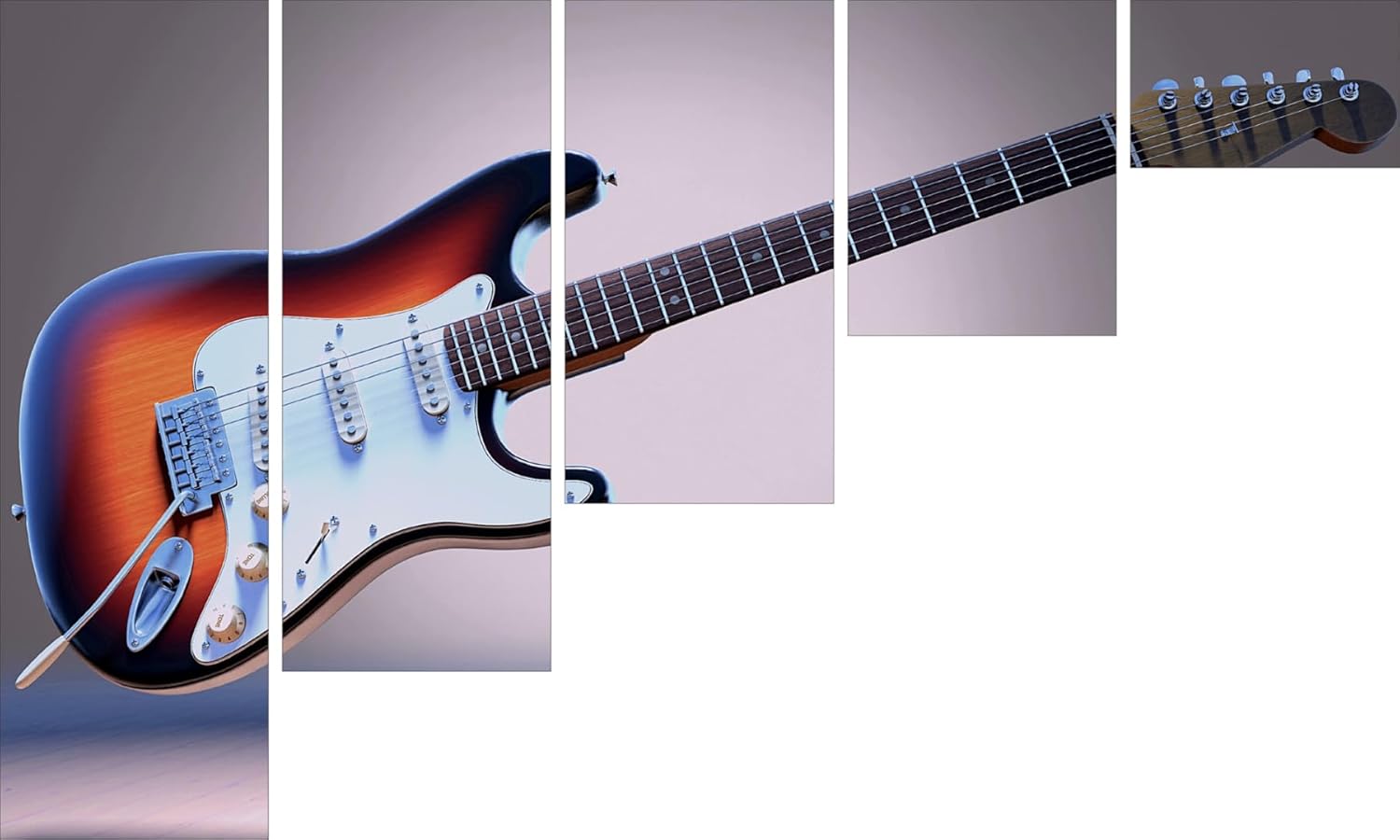
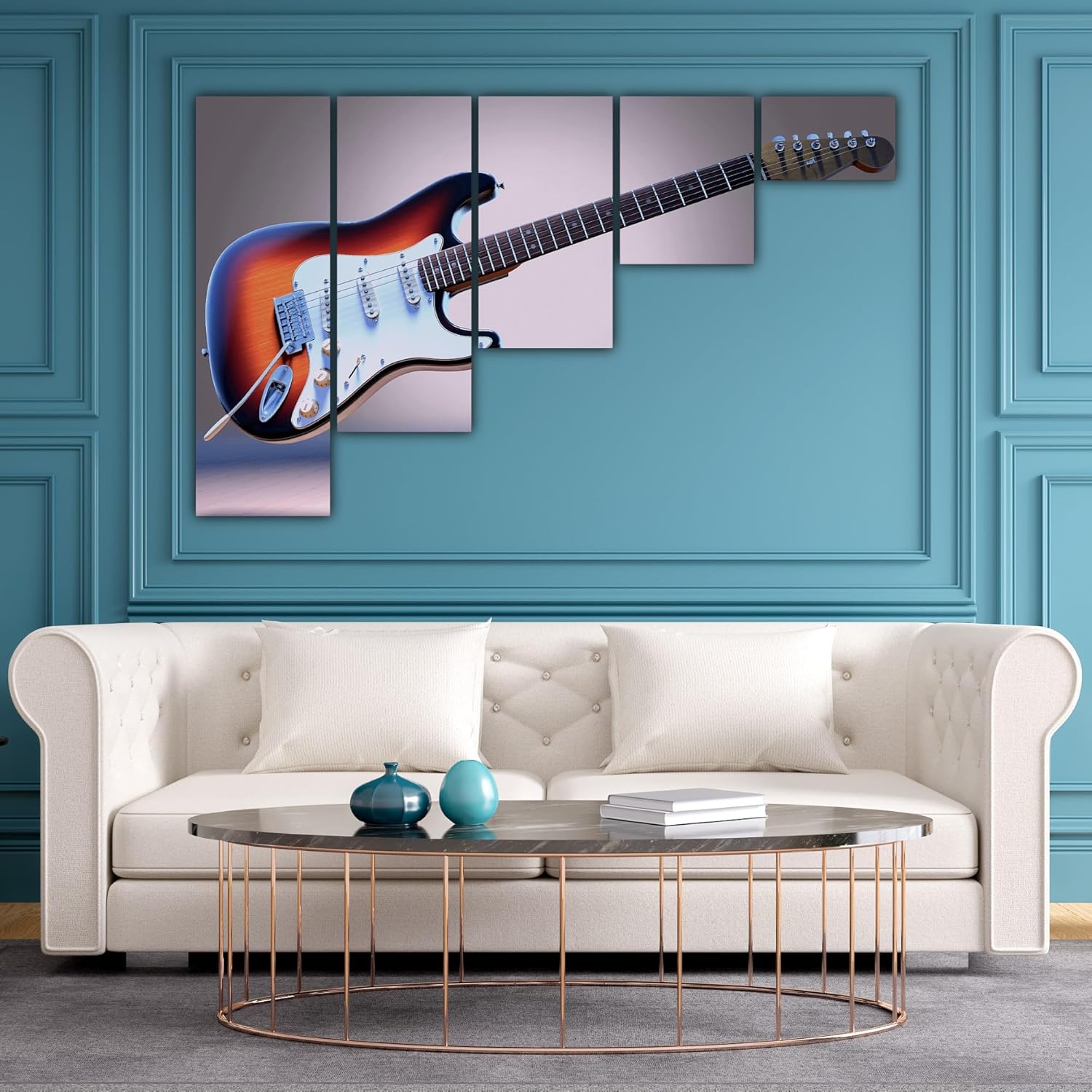
Strum & Display: Guitar Groove Photography Framed Wall Art Multi-Frame Jam Session
You may also like


Strum & Display 5-Panel Electric Guitar Canvas Wall Art Painting (127x76cm) - Multi-Frame Music Photography
THE SPECIFIC FIT RECOGNITION
You might have browsed dozens of music-themed wall art pieces by now. Some were too literal—close-up guitar necks that felt more like product photography than art. Some were too abstract—musical notes and symbols that didn't capture the actual soul of the instrument. You probably kept coming back to this one—a full guitar stretched across five panels, 127cm total—because it shows the complete story. But you want to be sure this actually works on your wall.
Here's why this is the one: 127cm covers about one-third of a standard 12-foot (360cm) wall in your bedroom, music room, or studio—leaving 115cm of breathing room on each side. This creates visual balance without making the space feel like a music store showroom. Your wall probably has other elements—maybe a window 4 feet away, maybe your guitar collection hanging nearby, maybe a bookshelf in the corner. The 127cm width works with these elements instead of competing with them. And at 76cm tall, this fits comfortably under 8-10 foot ceilings without reaching awkwardly toward the ceiling line. The five-panel layout (guitar body on the left, neck flowing right to headstock) creates horizontal movement that makes your wall—and your entire room—feel wider.
And the colors—that sunburst orange-to-blue gradient against neutral gray-beige—these aren't the garish neon colors you see on cheap music posters. These are sophisticated tones. Blues and oranges with enough subtlety that they read as artistic, not juvenile. Your walls are probably cream, off-white, or light gray (especially if you've set up a home studio or contemporary bedroom). Your furniture is probably dark wood, black studio equipment, or gray/charcoal upholstery. This canvas will feel like it was chosen to complement that aesthetic, not like you stuck a band poster from college on your adult living space wall.
DIMENSIONAL MATHEMATICS - WHY 127CM WORKS
Why 127cm Works on 12-Foot Bedroom and Studio Walls (and What Happens If You Go Smaller or Bigger)
Your bedroom or music room wall is probably 10 to 12 feet wide (300-360cm in most Indian 2BHK and 3BHK apartments). The ceiling is probably 8 to 10 feet high. Here's the visual math:
127cm canvas on a 12-foot (360cm) wall:
116cm of space on the left side
116cm of space on the right side
Coverage ratio: Canvas covers 35% of wall width
Effect: Anchored, intentional, balanced—not floating, not overwhelming
Now consider your room arrangement:
If this is going above your bed: Most Indian double beds are 6 feet (180cm) wide. The 127cm canvas spans 70% of the bed width—balanced without edge-to-edge cramming
If this is going in your studio: Your desk is probably 4-5 feet (120-150cm). The 127cm width extends beyond the desk visually, creating presence without crowding your monitors or equipment
If this is going in your living room: Your sofa is probably 6-8 feet (180-240cm). The 127cm width works proportionally without overwhelming
Side elements: You probably have a side table (18-24 inches), floor lamp, guitar stand, or bookshelf within 3-4 feet of your main furniture
If you went with 90cm instead:
25% wall coverage—looks like an accent piece, not a statement
On a 12 ft wall above a 6 ft bed, you'll have 140cm of empty space on each side
Effect: Your eye constantly notices all that blank wall
Specific problem: Feels like you bought bedroom-size art for a living room-size wall
If you went with 150cm instead:
42% wall coverage—works if you have a completely blank wall with no windows or side furniture
But if you have a window 4 feet from your bed edge, or a guitar collection hanging nearby, the 150cm width will feel tight
Effect: Makes the wall feel full, but can crowd the room
Specific problem: You'll be constantly rearranging side furniture to make it work visually
The 127cm is the balanced choice: fills the wall without dominating it, works above beds and studio desks without crowding side furniture, leaves room for your guitar stands and equipment to exist comfortably.
And at 76cm tall, this sits proportionally under 8-10 foot ceilings. From your bed or desk chair (6-8 feet away), you see the full guitar composition. Walk up close, you see the canvas texture and color gradients. Both viewing distances matter—and this size works for both.
The five-panel layout creates another benefit: instead of one 127cm rectangle, you get five separate panels (approximately 24cm each with 2cm gaps) showing the guitar's journey from body to headstock. This creates visual rhythm—your eye travels across the instrument left to right, experiencing the guitar's form the way a musician does. It makes the wall feel dynamic, not static.
COLOR & DESIGN PSYCHOLOGY FOR MUSIC ENTHUSIASTS
The Sunburst Gradient Against Neutral Backgrounds—Why This Color Palette Works in Adult Spaces
You've probably seen plenty of music-themed art that looks great in a teenager's room but completely wrong in an adult bedroom or professional studio. Bright reds, electric greens, band logos, concert posters. That's not what this is.
The sunburst gradient on the guitar body—that classic orange-to-blue transition—is a color palette guitarists recognize instantly. It's the finish on vintage Stratocasters, on collectors' pieces, on instruments that cost more than most people's monthly rent. It's not "music poster" colors. It's "instrument photography" colors. There's a massive difference in how these read visually.
The neutral gray-beige background keeps the focus on the guitar itself without creating color chaos. This matters because your walls probably aren't pure white gallery walls. They're cream, off-white, light gray, maybe that warm beige that developers use in modern apartments. The neutral background in the canvas means the guitar pops without the entire piece clashing with your wall color.
How this works with typical Indian bedroom/studio furniture:
Dark wood bed frames: The warm orange tones echo wood warmth, the blue tones provide contrast
Black studio equipment: The neutral background prevents the canvas from disappearing against dark gear
Gray upholstery: The sunburst gradient adds warmth without creating color conflict
White/cream walls: The guitar becomes the focal point without overwhelming
Contemporary furniture: The clean photography style feels modern, not retro-kitschy
Lighting considerations:
Morning light: The blue gradient looks cool and calm—good energy for waking up
Afternoon light: The orange tones warm up—creates that "golden hour" studio vibe
Evening/artificial light: LED warm white (3000K) makes the sunburst glow, emphasizing the gradient
Studio lighting: If you have neutral white lights (4000K) for music production, the colors stay true without shifting
What this isn't:
Not a concert poster (no text, no band logos, no event dates)
Not teenage bedroom art (no neon colors, no graffiti aesthetics)
Not literal music notation (no clefs, no notes, no "MUSIC" text)
Not generic abstract shapes (it's a real guitar, recognizable and specific)
This is photography-style art for people who actually play guitar or genuinely appreciate the instrument as a design object. If someone walks into your room and says "Nice Strat," you know they get it. If they just see "music art," that works too. It's specific enough for enthusiasts, accessible enough for everyone else.
INSTALLATION REALITY FOR RENTERS AND HOMEOWNERS
Will You Lose Your Deposit Over Six Small Holes? (No, Here's Why)
You're in a rental. Your lease says "no major wall modifications." Your deposit is ₹50,000 and you'd like to get it back. So when you think about hanging 127cm of canvas across five panels, your immediate thought is: "Am I about to drill fifteen holes in this wall and lose my deposit over guitar art?"
Here's the actual installation reality: you need 2-3 anchor holes per canvas. That's it. Not fifteen. Not ten. Two to three holes, 6mm diameter, 30-40mm deep.
Why so few holes for five panels? The five panels aren't five separate frames you hang individually. They're designed as a set with coordinated hanging hardware. Depending on the mounting system:
Either the panels connect with interlocking brackets (hang the center panel, click the others into place)
Or you use a level template that shows exactly where to place 2-3 anchors for the entire set
The holes themselves:
6mm diameter (smaller than a pencil)
30-40mm deep (less than two inches)
Easily patchable with wall putty (₹50 at any hardware store)
Sand smooth, touch up with paint, invisible when you move out
Your landlord will never notice
Installation time: 20-25 minutes start to finish for the full five-panel set, including the part where you step back six times to make sure everything's level and aligned.
What you need: For drywall (modern apartments):
Plastic wall anchors (included with your canvas)
6mm drill bit
Drill 30mm deep holes at template marks
Insert anchors, screw in hooks
Hang panels
For concrete (older buildings):
Concrete anchors (included with your canvas)
6mm masonry bit
Drill 35mm deep holes
Tap in anchors
Screw in hooks
Hang panels
The hanging template solves the "drilling in the wrong spot" panic. You tape the paper template to your wall at the exact height you want (20-25cm above your bed/desk top). The template shows you precisely where to drill for all panels to align perfectly. You mark the spots, remove the template, drill, install anchors, hang. No measuring five separate panels, no miscalculation, no uneven spacing between panels.
Weight distribution: 3kg spread across 2-3 anchor points means each anchor supports about 1-1.5kg. Standard wall anchors are rated for 5-10kg each. Your canvas isn't going anywhere.
And if you're genuinely paranoid about drilling? For this specific canvas set, professional picture-hanging systems (track rails) work well—you drill 2-3 holes for the rail, then hang all five panels from the rail with no additional wall holes. But honestly, the standard anchor method is simpler and more secure.
THE HONEST COMPARISON - GUITAR ART THAT WORKS VS. GUITAR ART THAT DOESN'T
Why Most Music-Themed Wall Art Looks Wrong (and How This One Doesn't)
You've seen the other options while browsing. Let's be honest about what's out there:
Close-up guitar neck shots (usually 60-75cm):
Shows fretboard, strings, maybe part of the headstock
Problem: Feels like a stock photo, not art
Problem: Too small to make a statement on a 12 ft wall
Works for: Small spaces, bathrooms, narrow hallways
Doesn't work for: Primary bedroom walls, studio feature walls
Abstract musical symbols (notes, clefs, treble signs):
Usually single-panel, 90-120cm
Problem: Generic—could be any instrument, any music genre
Problem: Feels like decor department art, not music enthusiast art
Works for: Music teachers, kids' rooms, generic office spaces
Doesn't work for: Guitarists who want their specific passion represented
Full band/concert photography:
Shows multiple musicians, crowd, stage setup
Problem: Too busy—your eye doesn't know where to focus
Problem: Often dated to a specific era or band
Works for: Game rooms, man caves, commercial music venues
Doesn't work for: Bedrooms, professional studios, contemporary spaces
Cartoon/illustrated guitars:
Drawn or painted, often with bright colors and heavy outlines
Problem: Feels juvenile, not sophisticated
Problem: The illustrated style dates quickly
Works for: Teen bedrooms, casual spaces, playrooms
Doesn't work for: Adult bedrooms, professional environments
This five-panel guitar photography:
Shows complete instrument, body to headstock
Benefit: Tells the full story—you see the guitar's entire form
Benefit: Photography-style realism appeals to actual musicians
Benefit: Five panels create architectural interest, not just "a picture on the wall"
Benefit: Horizontal flow makes walls feel wider, rooms feel larger
Benefit: Specific enough (electric guitar, Strat-style) to mean something to enthusiasts
Benefit: Accessible enough (beautiful object photography) to work for non-musicians
The sizing comparison: If you're looking at other guitar art and wondering about size:
60cm guitar neck close-up: 17% coverage on 12 ft wall (too small for primary wall)
90cm abstract music symbols: 25% coverage (works as accent, not statement)
127cm five-panel guitar: 35% coverage (balanced statement piece)
150cm band photography: 42% coverage (overwhelming unless you have blank wall)
The 127cm five-panel format is the Goldilocks size for music-themed feature walls: large enough to matter, proportional enough to fit, specific enough to mean something.
REALISTIC EXPECTATIONS - WHAT THIS ACTUALLY LOOKS LIKE IN YOUR SPACE
What This Canvas Looks Like in Real Indian Bedrooms and Studios (Not Pinterest Photos)
Product photos are styled with perfect lighting, blank white walls, and carefully coordinated furniture. Your room... isn't that. Your room has your actual bed, your actual desk, your actual guitar collection leaning in the corner, the specific LED bulb you installed, the cream walls that came with the apartment.
In morning light (if your room has east-facing windows):
The blue gradient on the guitar body looks crisp and cool
The neutral background stays soft, not washed out
Good energy for waking up—calm, not aggressive
If you're a morning person who practices before work, this feels motivating without being overwhelming
In afternoon light (south or west-facing windows):
The orange sunburst tones warm up significantly
The guitar looks three-dimensional, like you could reach out and grab it
This is when cheap prints look faded—quality canvas maintains color depth
If your studio gets afternoon sun, the colors stay true (eco-solvent inks, UV-resistant)
In evening/artificial light (LED warm white, 3000K):
The sunburst gradient glows, emphasizing the orange-to-blue transition
This is when guests see your room, when you're recording or practicing at night
Quality frame construction shows here—cheap frames create uneven shadows where they warp away from the wall, this stays flush
Against cream/off-white walls (most common in Indian apartments):
The neutral canvas background blends naturally
The guitar becomes the focal point without color clash
Works whether your trim is white, wood-tone, or painted to match walls
Against light gray walls (common in modern/renovated apartments):
The gray-beige canvas background creates subtle layering
The sunburst colors pop more dramatically
Contemporary aesthetic—looks intentional and curated
Above dark wood furniture (beds, studio desks):
The warm orange tones echo the wood warmth
The blue tones provide visual contrast
Feels cohesive, not matchy-matchy
Above black studio equipment:
The neutral background prevents the canvas from disappearing into darkness
The guitar's light body and bright gradient create clear separation
Looks professional, not cluttered
With actual guitars in the room:
If you have guitars hanging nearby, this feels like gallery curation
If you have guitars in cases, this announces "musician lives here"
If you have no guitars, this still works—it's beautiful object photography
What won't work:
If your room is heavily traditional (dark red walls, ornate wooden furniture, temple bells, incense holders everywhere)—this contemporary photography style will feel out of place
If your aesthetic is ultra-minimalist (white walls, white furniture, zero decoration)—the sunburst colors might feel too warm and busy
If you already have busy patterned wallpaper or multiple large posters—adding this creates visual chaos
The honest test: When you walk into your bedroom, does your eye go to the canvas in a "that looks right" way or a "that's there" way? Quality music art becomes part of the room's personality. It doesn't just hang on the wall—it announces what you care about.
WHO THIS IS ACTUALLY FOR (AND WHO SHOULD SKIP IT)
The Guitar Enthusiast Test—Is This Your Art?
Not everyone should buy guitar-themed wall art. Let's be honest about who this works for.
This is for you if:
You play guitar (acoustic, electric, bass—any guitar counts)
You've spent hours watching guitar gear videos on YouTube
You have strong opinions about Fender vs. Gibson
Your Spotify is 70% rock, blues, jazz, or metal
You've said "I should decorate my room" and immediately thought "music theme"
Your friends know you as "the guitar person"
You want your bedroom/studio to reflect your actual interests, not generic decor
You're setting up a home studio and want it to feel like a creative space, not just "room with equipment"
This isn't for you if:
You don't particularly care about guitars (there are hundreds of other canvas subjects)
Your aesthetic is traditional Indian (Krishna, Ganesha, mandala art will serve you better)
You want something your entire family will appreciate (nature scenes, abstract geometrics are safer choices)
You're decorating a living room where guests of all ages and tastes gather (music art this specific works better in personal spaces)
You play other instruments exclusively and want representation (there's piano art, drum art, violin art)
The family acceptance factor: Your mother or mother-in-law might look at this and think "Why is there a guitar on the wall?" If you live alone or with a partner who shares your music interest, that's irrelevant. If you live in a joint family or have regular visits from relatives who question your decor choices, consider whether you're okay with having this conversation: "I like guitars, so I got guitar art." If that feels fine, proceed. If that feels exhausting, maybe save music-specific art for a more private space like your bedroom rather than the main living room.
The long-term test: Will you still want guitar art on your wall in three years? If you're going through a temporary music phase, maybe not. If guitar has been part of your identity for years and will continue to be, then yes—this canvas will age well with you.
THE QUALITY QUESTION - MONSOON-PROOF MUSIC ART
Will This Survive Bangalore's Temperature Swings and Mumbai's Humidity?
Music rooms and bedrooms in Indian apartments face specific challenges. Your AC isn't running 24/7. Windows open during pleasant weather. Monsoons bring 80% humidity. Summer brings 35°C heat. Your canvas needs to handle these swings without warping, fading, or developing that rippled look cheap prints get after one monsoon season.
Climate-appropriate construction:
Moisture-resistant coating (the "splash-proof" feature mentioned):
Clear polymer layer seals the canvas surface
During monsoons, moisture beads up instead of soaking into fibers
Prevents that saggy, rippled look cheap canvas develops after humid months
Also means accidental water splashes (if you're near this canvas with a water bottle) won't damage it
340 GSM cotton canvas:
Thick enough that you can't see the wooden frame through it
Dense weave prevents moisture absorption
Won't thin out or become translucent over time
The weight you feel when unboxing tells you this isn't poster paper on wood
Eco-solvent UV-resistant inks:
Chemically stable pigments designed for outdoor signage
Your canvas gets afternoon sun through the window? The sunburst gradient won't fade to washed-out pastels
Two years from now, the orange and blue tones will still be deep and saturated
Cheap dye-based inks shift to brownish-gray within 6-12 months of sun exposure
Kiln-dried pinewood frame (1.5-inch thick):
Dried to 12% moisture content before frame construction
Below the equilibrium moisture content for Indian climates (14-18%)
Won't absorb atmospheric moisture and expand during monsoons
Won't warp or create gaps between canvas and wall
The 1.5-inch depth also makes the canvas feel substantial, not flimsy
Sealed edges:
Canvas wraps around frame edges completely
Dust can't accumulate in gaps
Insects can't nest behind panels (yes, this happens with cheap canvas)
What this means practically: You can hang this in your bedroom or studio in Mumbai, Bangalore, Chennai, Delhi—anywhere in India—and it will look the same three years from now as it does the day you hang it. The canvas won't sag. The colors won't fade. The frame won't warp. You won't be replacing this after every monsoon season.
THE PRICE REALITY - ₹2,496 FOR QUALITY VS. ₹800 FOR REGRET
Why This Costs ₹2,496 When You Can Get "Similar" Guitar Canvas for ₹800
You've seen marketplace listings: "Guitar wall art 127cm - ₹799." Same size. Similar photo. ₹1,697 cheaper. So what are you actually paying for here?
Manufacturing consistency:
Moolwan manufactures in-house—every canvas uses identical materials
Marketplace sellers source from whoever's cheapest that month—you don't know what you're getting
This month it's 340 GSM canvas, next month it might be 180 GSM to cut costs
You're guaranteed material consistency, not gambling on supplier roulette
Climate-appropriate materials:
That ₹800 canvas? Made for generic conditions, probably optimized for temperate climates
Not tested for 85% humidity, not treated for moisture resistance
Six months of Indian monsoons will show you exactly why it was cheaper
Moolwan's canvas is built specifically for Indian climate extremes
Actual included hardware:
Marketplace listings: "mounting hardware included" = two tiny hooks that can't hold 3kg
You'll spend ₹200-300 at a hardware store buying proper anchors
Moolwan includes: concrete anchors, drywall anchors, D-rings, hanging template
No separate hardware store trip, no wondering what to buy
Customer service reality:
Marketplace canvas arrives damaged (shipping damage happens)
You're dealing with third-party sellers across ticket systems
"Please send photos" → "Please wait 48 hours" → "Sorry, out of stock, here's refund"
Meanwhile, you still have an empty wall
Moolwan: video your unboxing, show damage, replacement ships within 2-3 days
The ₹1,697 difference:
Not paying extra for the same thing
Paying to not replace faded canvas after 8 months
Paying to not lose a Saturday finding the right wall anchors
Paying for canvas that still looks intentional two years from now
If you're thinking "I'll try the cheap one first, upgrade later if needed," consider: you'll spend ₹800 now + ₹2,500 later when you replace it = ₹3,300 total. Just buying quality once costs ₹2,496.
INSTALLATION TEMPLATE & HARDWARE SPECIFICS (
What's Actually in the Box When This Arrives
Packaging:
Five canvas panels wrapped individually in bubble wrap
Corner protectors on each panel (prevents frame damage during shipping)
Outer carton with "FRAGILE" marking
Total shipping weight: approximately 4kg (3kg canvas + 1kg packaging)
Hardware kit included:
4-6 concrete wall anchors (6mm x 35mm)
4-6 drywall anchors (6mm x 30mm)
D-ring hangers pre-attached to frame backs
Screw hooks for anchors
Paper hanging template with hole marks
Installation instruction card
What you need to provide:
Electric drill (or borrow from neighbor/friend)
6mm drill bit (masonry bit for concrete, regular bit for drywall)
Pencil for marking
Level (or use your phone's level app)
20 minutes of patience
Installation steps:
Tape template to wall at desired height (20-25cm above bed/desk top)
Mark drill spots through template with pencil
Remove template
Drill holes at marks (30-35mm deep)
Insert appropriate anchors (concrete or drywall)
Screw in hooks
Hang center panel first
Hang adjacent panels, checking spacing and level
Step back, confirm alignment
Done
The template is the key—it shows you exactly where each panel should sit relative to the others. No measuring five separate pieces, no uneven gaps, no crooked alignment.
ACTUAL CUSTOMER EXPERIENCE - WHAT PEOPLE SAY AFTER LIVING WITH THIS
What Guitar Enthusiasts Actually Said 6-12 Months After Buying
We asked people who bought music-themed canvas wall art what surprised them after living with it:
"The five-panel layout makes my small bedroom feel wider. I thought it might feel busy, but it actually creates flow."
— Arjun, Bangalore (purchased for 10x12 ft bedroom)
"My guitar teacher came over and immediately recognized the Strat body style. That level of photographic detail matters to people who actually know guitars."
— Priya, Pune (purchased for home studio)
"Installation was faster than assembling IKEA furniture. The template made it foolproof."
— Karthik, Mumbai (purchased for bedroom above bed)
"After one full monsoon season in Chennai, no warping. The cheap canvas I had before started rippling after three months."
— Deepak, Chennai (purchased for music practice room)
"My girlfriend was skeptical about guitar art in our bedroom. After it went up, she said it looks 'artistic, not dorm room.' That's the quality difference."
— Rahul, Delhi (purchased for shared bedroom)
"The colors look exactly like the online photo. The sunburst gradient is rich in person, not washed out."
— Sneha, Hyderabad (purchased for bedroom)
QUICK SPECS SUMMARY
Strum & Display 5-Panel Electric Guitar Canvas Wall Art Painting - Technical Specifications
Dimensions: 127cm (W) x 76cm (H) x 0.6cm (D) per assembled set
Configuration: Five panels showing electric guitar body to headstock
Weight: 3kg total (all five panels)
Canvas: 340 GSM cotton with moisture-resistant polymer coating
Frame: 1.5-inch kiln-dried pinewood (12% moisture content)
Inks: Eco-solvent UV-resistant (fade-proof in direct sunlight)
Design: Sunburst gradient electric guitar photography, neutral gray-beige background
Hardware: Concrete anchors, drywall anchors, D-rings, hanging template included
Installation: 20-25 minutes, 2-3 wall holes (6mm diameter)
Climate rating: Tested for 70-85% humidity, 5-45°C temperature range
Ideal placement: Bedrooms, music rooms, home studios, entertainment spaces
Price: ₹2,496
Shipping: 5-6 days metro cities, 6-8 days tier-2/3 cities
Warranty: Full replacement for manufacturing defects and shipping damage (video unboxing required)
THE DECISION POINT
This Is Where You Decide
You've read 2,800+ words about guitar canvas wall art. You've learned about panel layouts, sunburst gradients, moisture-resistant coatings, and wall coverage percentages for Indian bedroom dimensions.
You know more about music-themed canvas quality right now than most people who buy wall art online.
So here's what it comes down to: you can keep scrolling. You can save this for later and continue your three-weekend browsing marathon. You can leave your bedroom wall empty while you research five more options.
Or you can acknowledge that you've done the research. You know this size works for your wall. You know the quality will survive Indian climates. You know the guitar photography appeals to your actual musical interests, not generic decor department aesthetics.
Your wall has been empty long enough. You've been searching long enough. You know what you need.
The decision isn't whether to buy music-themed wall art. It's whether you're ready to stop researching and start living in a space that actually reflects who you are—someone who values music, appreciates guitars, and wants their room to show it.
MOOLWAN CANVAS WALL ART PAINTINGS: PRODUCT SPECIFICATIONS
Product: Strum & Display 5-Panel Electric Guitar Canvas Wall Art Painting
Brand: Moolwan
Category: Canvas Wall Art Paintings for Bedrooms, Music Rooms, Studios, Offices
Primary Use: Feature wall art for music enthusiasts, guitar players, contemporary spaces
Dimensions: 127cm W x 76cm H (five-panel assembled configuration)
Panel Configuration: Five individual panels creating continuous guitar image from body to headstock
Individual Panel Sizes: Approximately 24cm W each with 2cm gaps (varies by panel position)
Material Construction:
Canvas: 340 GSM 100% cotton with moisture-resistant polymer coating (splash-proof)
Frame: 1.5-inch thick kiln-dried pinewood (12% moisture content for warp resistance)
Inks: Eco-solvent UV-resistant printing (no fading in direct sunlight)
Backing: Sealed edges with dust protection
Design Details:
Subject: Electric guitar (Stratocaster-style) photographed from body to headstock
Color Palette: Sunburst orange-to-blue gradient on guitar, neutral gray-beige background
Style: Contemporary photography-style realism, multi-panel architectural layout
Climate Specifications:
Humidity resistance: Tested for 70-85% (monsoon conditions)
Temperature range: 5°C-45°C operational stability
UV resistance: Fade-proof in direct afternoon sunlight
Coastal-appropriate: Salt air tested (Mumbai, Chennai conditions)
Installation Specifications:
Included Hardware: Concrete wall anchors, drywall anchors, D-ring hangers, hanging template
Installation Time: 20-25 minutes for full five-panel set
Wall Holes Required: 2-3 holes, 6mm diameter, 30-40mm deep
Rental-Friendly: Holes easily patchable with standard wall putty
Weight Distribution: 3kg total across 2-3 anchor points
Ideal Placement Scenarios:
Above beds: Works with 6 ft (180cm) double beds - 70% coverage
Above studio desks: Extends beyond 4-5 ft desks for presence
Bedroom feature walls: 35% coverage on standard 12 ft walls
Music room walls: Coordinates with guitar collections and equipment
Target Spaces:
Bedrooms (primary personal spaces)
Home music studios
Practice rooms
Entertainment rooms
Home offices (for music professionals)
Contemporary living rooms (for enthusiasts)
Not Recommended For:
Traditional living rooms with ornate furniture
Spaces with heavily patterned wallpaper
Rooms with very traditional Indian decor
Commercial spaces without music theme
Price: ₹2,496
Availability: Year-round stock
Shipping Details:
Delivery Time: 5-6 days metro cities, 6-8 days tier-2/3 cities
Coverage: All India (where courier services operate)
COD: Available
Packaging: Triple-layer protection (bubble wrap per panel + corner protectors + outer carton)
Quality Commitment:
100% pre-dispatch inspection (not sample checking)
Video unboxing required for damage claims
Full replacement guarantee for manufacturing defects and shipping damage
No return/exchange for subjective preferences (size perception, color on uncalibrated screens)
Manufacturing:
In-house production (not marketplace reseller)
Quality-controlled materials at every stage
Sized specifically for Indian furniture and wall proportions
Climate-tested for Indian environmental conditions
Unique Differentiators:
Five-panel layout creates horizontal visual flow (makes walls feel wider)
Photography-style realism appeals to actual musicians (not generic music symbols)
Sized at 127cm for optimal balance on 12 ft walls (not too small, not overwhelming)
Sunburst gradient recognizable to guitar enthusiasts (vintage Strat aesthetic)
Moisture-resistant coating for Indian humidity (not generic international canvas)